

4 Setup And Payoff Principles That Make Scenes Land
Why your callbacks feel forced instead of inevitable

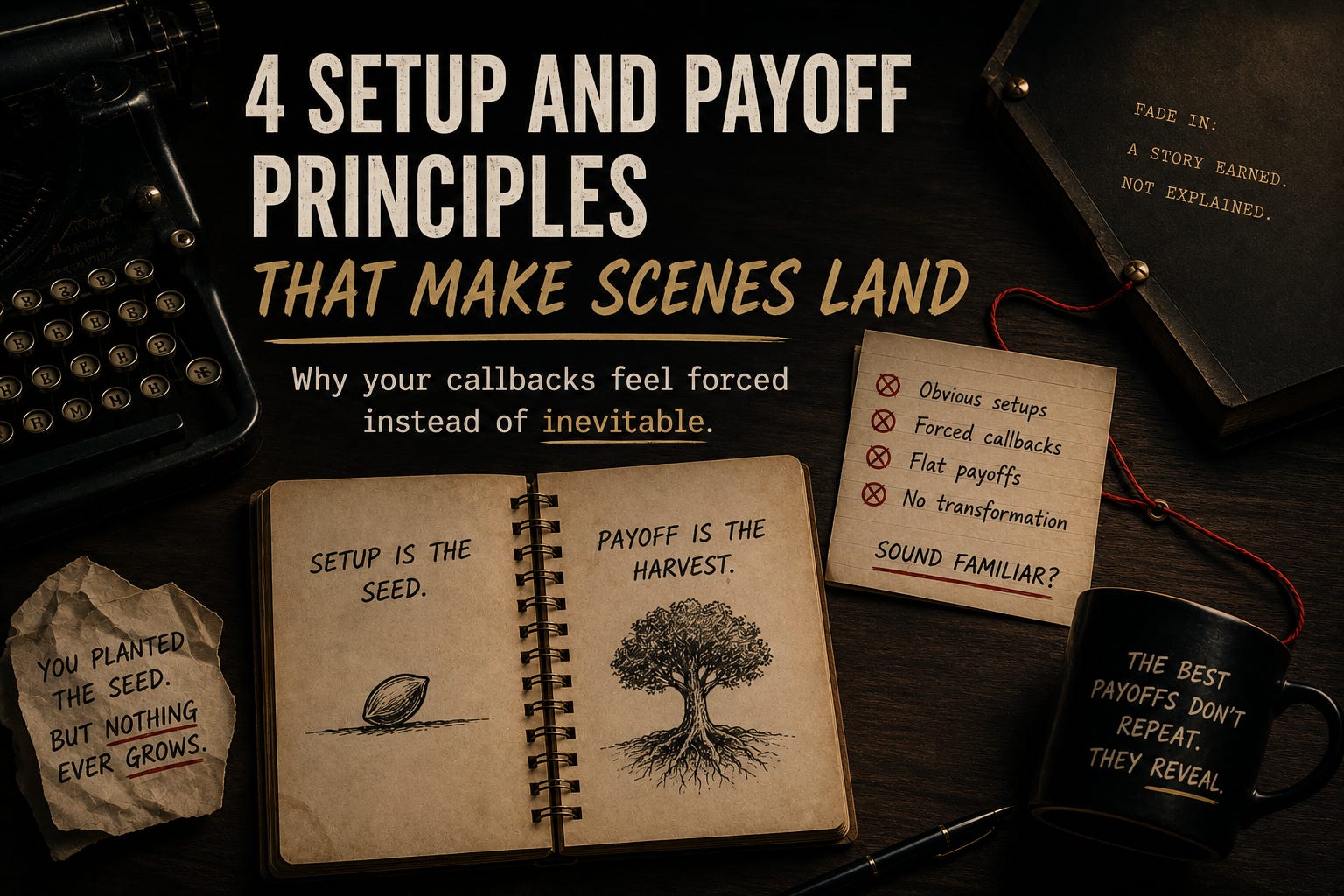
I used to think setup and payoff was simple. Don’t we all as screenwriters at some point? We’ve seen enough movies and TV shows, read enough comic books, and heard enough stories that we feel it all makes sense to us, right?
It’s simple, isn’t it?
You introduce something early. You bring it back later. Bam! Callback. The audience laughs or feels something. You’re done. You’ve been a good screenwriter.
At least that’s what I thought.
So I’d plant things, obviously. Make sure the audience couldn’t miss the setup. Then return to it exactly as I’d set it up.
And the payoffs felt flat.
Why? Because I didn’t understand that setup and payoff aren’t about just a wash, rinse, repeat approach. To create an effective setup and payoff requires transformation.
The setup plants a seed. But the payoff has to harvest something completely different than what was planted.
What about you? Are you making the same mistake?
Does any of this sound familiar? You set something up clearly. Maybe a character trait. Maybe a detail. Maybe a joke. Then you bring it back thinking that’s enough.
But the payoff doesn’t land because you’re just repeating. You’re not transforming.
After 26 years of writing and analyzing scripts that work, I’ve identified four principles that separate setups that land from ones that feel forced.
Because setup and payoff is one of the most misunderstood technical elements in screenwriting. And it’s still something I’m working to master in my own writing work. So this article is as much for my own writing journey as it is for yours.
Today I’m breaking down those four principles, what each one teaches you, why most writers skip them, and how to use them so your callbacks actually land instead of just existing.
Here are my four principles of set up and payoff that you can start incorporating into your own screenwriting work today.
Principle #1: The Setup Needs To Be Invisible
Your audience should register the setup without knowing they’re registering it.
Most writers plant setups so obviously the audience knows they’re being set up. A character mentions they’re afraid of heights. Later, they have to climb. We see the setup coming from a mile away.
That’s a billboard, not a setup.
A real setup lives in the details. In behavior. In something that seems casual in the moment but becomes meaningful later.
In Breaking Bad, Walter mentions he’s never been “truly happy” in his marriage. It seems like character information. Backstory. A casual line.
Later, that line becomes the emotional center of the entire series. But in the moment, most viewers don’t register it as important. They register it as Walter sharing something about his life.
That’s an invisible setup.
Why this matters:
When audiences know they’re being set up, they stop trusting you. They feel manipulated. They brace for the payoff instead of being surprised by it.
When the setup is invisible, the payoff feels inevitable in retrospect. Like of course that was the answer. Of course that matters.
How to do it:
Plant your setup in behavior or casual dialogue. Not in exposition. Not in a character explaining something for the audience’s benefit.
The setup should serve the scene it’s in. It should do something. Reveal character. Build conflict. Move the story forward.
The audience shouldn’t be able to point at it and say “that’s the setup.” They should only realize it was a setup when the payoff lands.
Principle #2: The Payoff Must Transform The Meaning Of The Setup
This is where most writers fail. It’s definitely where I struggle the most in my own writing.
They plant something and then bring it back exactly as it was planted. Same meaning. Same function. Just in a different scene.
That’s got callback written all over it, not payoff.
A real payoff transforms the meaning of what was set up.
In Jaws, early in the film Brody mentions his fear of water. He’s a police chief who’s afraid of the ocean. It’s introduced as a character quirk. Establishing his problem.
Later, that fear becomes the emotional center of his journey. His fear doesn’t go away. But by the climax, he conquers it anyway. The setup meant “I’m afraid.” The payoff means “I face what terrifies me anyway.”
The detail is the same. The meaning is completely transformed.
Why this matters:
If your payoff just repeats the setup, it feels redundant. We’ve already seen this. Why show it again?
But if the payoff transforms the meaning, suddenly the whole story recontextualizes. We see what the character has learned. What they’ve become.
How to do it:
When you’re planning your payoff, ask yourself, “What does this mean now that wasn’t true when it was set up?”
If your setup was about fear. Then your payoff needs to be about courage born from that fear.
If your setup was about weakness. Then your payoff needs to be about strength built despite that weakness.
If your setup was about a lie. Then you payoff needs to be about the truth underneath that lie.
Always remember that the setup and payoff use the same material, but they mean something completely different.
Principle #3: Distance And Timing Change How The Payoff Lands
How far apart your setup and payoff are completely changes how the audience experiences both.
Close payoffs (within a few scenes) feel like jokes or immediate consequences. The audience sees the connection easily.
Distant payoffs (separated by a full act) feel like discoveries. The audience has almost forgotten the setup. When the payoff lands, it feels surprising.
But there’s a sweet spot you’ll start to find the more you write. After all, too close and it feels obvious. Too far and the audience forgets.
In The Godfather, Michael’s transformation is set up early. He’s the war hero. The outsider. The one who swears he won’t become like his father.
But the payoff—when he fully commits to becoming the Godfather—doesn’t land until late in the film. By then, enough has happened that we’ve forgotten his original idealism. When he sits at that table, we realize how far he’s fallen.
If that payoff came five scenes after the setup, it would be obvious. We’d see it coming.
The distance creates the weight.
Why this matters:
Distance changes whether a payoff feels earned or manipulative. If you do it too close it feels calculated, more audience manipulation than effective storytelling. If you end up stringing it out too far, your story feels disconnected.
The right distance makes the payoff feel inevitable in retrospect but surprising in the moment.
How to do it:
Don’t plan your payoffs too close to your setups. Give the audience time to forget. Let other things happen. Build a different story.
Then when the payoff lands, it will feel like a discovery instead of a punchline.
But also don’t spread them too far apart. The audience needs to remember the setup somewhere in their subconscious.
The sweet spot usually looks something like this: setup in Act 1, payoff in Act 2 or 3. By separating them with enough story, these don’t feel obvious, while still ensuring that they’re close enough the audience can still make the connection.
Principle #4: The Payoff Requires The Character To Be Different
This is the principle that separates great payoffs from mediocre ones.
Your character changes between setup and payoff. They have to, otherwise why in the hell are we watching the story in the first place, right?
So it’s critical to understand that who they are at the setup HAS TO BE different from who they are at the payoff.
And it’s that very difference that makes the payoff land.
In It’s a Wonderful Life, George Bailey sets up his dream to leave his small town. To build, to design, to escape. That’s who he is at the beginning.
The payoff comes when he realizes he’s built something bigger than he ever imagined. His small town is his legacy. His life is his design.
Same person. Same town. But he’s completely different. His perspective has transformed.
That transformation is what makes the payoff work.
Why this matters:
If the character is the same when the payoff lands, there’s no arc. There’s no growth. The payoff is just something that happens.
But if the character has changed, the payoff shows us that change. It shows us their journey through the transformation.
How to do it:
Make sure your setup reveals who your character is at the beginning. Their belief. Their fear. Their desire.
Then as your script progresses, let them change. Let them learn. Let them become someone different.
When the payoff lands, it should show us that transformation. The setup and payoff are the same detail. But filtered through a completely different character.
How These Principles Work Together
I rewrote a script applying these four principles.
The setups were already there. But they were too obvious. The payoffs were too close. The character wasn’t changing enough.
I made the setups invisible. Buried them in behavior instead of stating them.
I moved the payoffs further away. Separated them from the setups by more story.
I made sure the character was fundamentally different by the time the payoff landed.
And suddenly the script transformed. The callbacks felt inevitable instead of calculated. The audience felt like they were discovering the story instead of following a plan.
Because the setup and payoff weren’t about repetition. They were about transformation.
The Bottom Line
Setup and payoff is more than just planting something and bringing it back.
Principle #1: The setup should be invisible. Buried in behavior, not stated.
Principle #2: The payoff must transform the meaning of the setup.
Principle #3: Distance matters. Timing changes how the payoff lands.
Principle #4: The character must be different when the payoff lands.
Test your script against these four principles. Are your setups obvious or invisible? Do your payoffs transform meaning or just repeat? Are they spaced right? Has your character changed?
If you’re failing any of these, your callbacks will feel forced instead of inevitable.
Which of these principles is your script missing? Where are your payoffs falling flat?
Drop it in the comments. Let’s find where your setups and payoffs need to be rebuilt.
Just came across you by accident
Really good article, love the examples you give as well. Like a cool drink on a hot day - much needed, thank you.