

The Five Questions I Ask Every Script
What separates scripts that work from scripts that feel like work

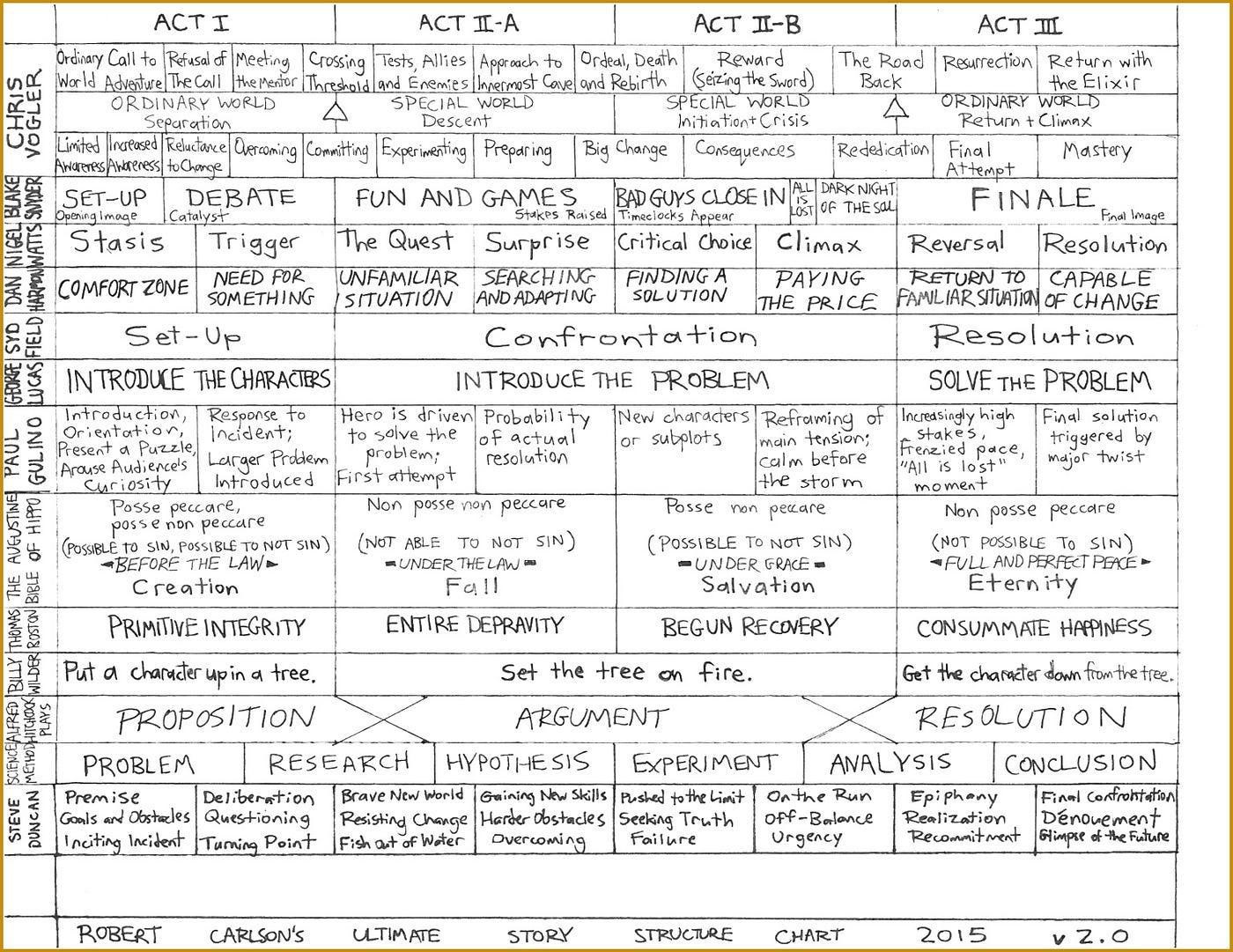
When I read a script, I don’t start with structure… Contrary to the entire layout of story structure options that the header image might suggest.
I don’t check if the turning points land on the right pages. I don’t count how many scenes are in each act. I don’t verify that the Save the Cat beats are where they’re supposed to be. (I used to do all of these things. Like, all the fucking time, and end up driving myself mad.)
Now, I ask five questions.
And those five questions reveal everything that’s broken about the script before I ever look at formatting or pacing or dialogue.
You’re probably reading scripts the wrong way too.
You’re looking at structure. At plot mechanics. At whether things happen in the right order.
But structure doesn’t tell you if the script actually works. Structure is just the skeleton. What matters is whether the skeleton has any flesh on it.
After 26 years of reading scripts, consulting on scripts, and writing scripts, I’ve narrowed down what actually matters to five questions. These are the questions I ask before I look at anything else.
Because if these five questions get answered correctly, everything else usually falls into place. And if they don’t get answered, no amount of structural perfection will save the script.
Today I’m breaking down those five questions, what each one reveals, why most writers never ask them, and how to use this framework to diagnose what’s broken in your own script.
This is the diagnostic work that comes before revision. Get this right and you know exactly what needs to be fixed.
Let’s dive in!
Question #1: Does The Character Have A Core Belief That Gets Tested?
This is the first thing I look for.
We could start with the plot. Or even the goal. But it’s far more impactful in revision if we start here because this is literally the heart of the story you’re telling. The heart of why we’ll go on this journey with your character, or if you’ll lose us by page 10.
So, how do we do this? It starts by asking these two deeper questions:
Does the character believe something about the world, about themselves, about what’s possible?
And does the story force them to confront whether that belief is true?
Your character might believe they’re unworthy of love. Or that loyalty is everything. Or that they can’t trust anyone. Or that they need to be in control.
That belief is their worldview. And the story should test it relentlessly.
If I can’t identify a core belief that gets challenged, the script feels hollow. Because the plot is just happening. The character is just moving through events.
But if the story is testing a belief, suddenly everything matters. Every choice the character makes reveals something about that belief. Every obstacle forces them to question it.
What this question reveals
If your script fails this question, you’re writing plot without character. You have events but no internal journey. The character is a passenger.
The fix is going back and identifying what your character believes. Then making sure every major scene tests that belief in some way.
